
 THE KELLEYS ISLAND NORTH SIDE CRUSHER TRAIL
Less than 1/5 mile long, this trail was established in 2025 and tells the story of quarrying on the Island and how the ruins of the crusher building were used. There are 7 plaques (2 overlook a former quarry pit) and a dedication plaque.
See all the plaques HERE as well as some additional photos.
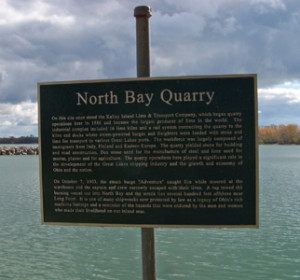
THE NORTH QUARRY & THE KELLEY’S ISLAND LIME & TRANSPORT CO.
This plaque is located on the shore just north of the State Park Beach. This was the location of the North Quarry dock, the lime kilns and the Northside quarry operation.
On this site stood the Kelley Island Lime & Transport Company, which began quarry operations here in 1886 and became the largest producer of lime in the world. The industrial complex included 16 lime kilns and a rail system connecting the quarry to the kilns and docks where steam-powered barges and freighters were loaded with stone and lime for transport to various Great Lakes ports. The workforce was largely composed of immigrants form Italy, Finland, and Eastern Europe. The quarry yielded stone for building and road construction, flux stone used for the manufacture of steel and lime used for mortar, plaster and for agriculture. The quarry operations here played a significant role in the development of the Great Lake shipping industry and the growth and economy of Ohio and the nation. On October 7, 1903, the steam barge “Adventure” caught fire while moored at the warehouse and the captain and crew narrowly escaped with their lives. A tug towed the burning vessel out into North Bay and the wreck lies several hundred feet offshore near Long Point. It is one of many shipwrecks now protected by law as a legacy of Ohio’s rich maritime heritage and a reminder of the hazards that were endured by the men and women who made their livelihood on our inland seas. READ MORE about the N. Side Crusher building.
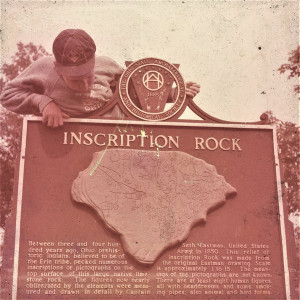
INSCRIPTION ROCK – KELLEYS ISLAND
Installed by the Ohio State Archeological and Historical Society, this plaque was removed sometime in the 1960-70s. It read: Between three and four hundred years ago, Ohio prehistoric Indians, believed to be of the Erie Tribe, pecked numerous inscriptions of pictographs on the top surface of this large native limestone rock. The figures, now nearly obliterated by the elements were measured and drawn in detail by Captain Seth Eastman, United Sates Army, in 1850. This relief of Inscription Rock was made from the original Eastman drawing. Scale is approximately 1 to 15. The meanings of the pictographs are not known. There are at least eight human figures, all with headdresses and some smoking pipes, also animal and bird forms.
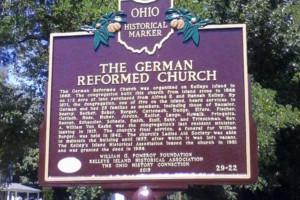
THE GERMAN REFORMED CHURCH
There are two different sides to this marker – one for the church itself and the other for the parsonage next door. They are located at 224 Division Street, just a short walk from the downtown area.
Side 1: The German Reformed Church was organized on Kelleys Island in 1865. The congregation built this church from island stone in 1866 on 1/2 acre of land purchased from Alfred S. and Hannah Kelley. By 1871, the congregation, one of five on the island, heard services in German and had 25 families as members, including those of Baumler, Beatty, Becker, Boker, Burger, Cattenach, Dodge, Elfers, Fischer, Gerlach, Hess, Huber, Jordon, Keifer, Lange, Nowalk, Pringnitz, Renter, Schaedler, Scheele, Smith, Stoll, Suhr, and Trieschman. Rev. A. William Von Kaske was the congregation’s last resident minister, leaving in 1915. The church’s final service, a funeral for William Burger, was held in 1942. The church’s Ladies Aid Society was able to maintain the building until 1957, after which it was left vacant. The Kelleys Island Historical Association leased the church in 1981 and was granted the deed in 1986. READ MORE HISTORY OF THIS CHURCH
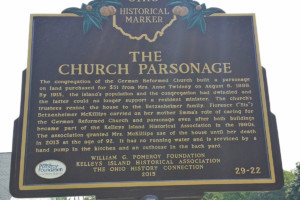
THE GERMAN REFORMED CHURCH – PARSONAGE
Located at 224 Division St, this is a 2-sided marker.
Side 2 – The congregation of the German Reformed Church built a parsonage on land purchased for $51 from Mrs. Anne Twidney on August 8, 1888. By 1915, the island’s population and the congregation had dwindled and the latter could no longer support a resident minister. The church’s trustees rented the house to the Betzenheimer family. Florence (“Sis”) Betzenheimer McKillips carried on her mother Emma’s role of caring for the German Reformed Church and parsonage even after both buildings became part of the Kelleys Island Historical Association in the 1980s. The association granted Mrs. McKillips use of the house until her death in 2013 at the age of 92. It has no running water and is serviced by a hand pump in the kitchen and an outhouse in the back yard. READ MORE ABOUT THIS HOUSE.
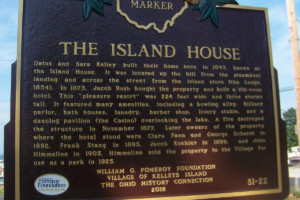 THE ISLAND HOUSE
Located in the downtown park at the intersection of Division and Lakeshore roads.
Datus and Sara Kelley built their home here in 1843, known as the Island House. It was located up the hill from the steamboat landing and across the street from the island store (the Lodge, 1854). In 1873, Jacob Rush bought the property and built a 102-room hotel. This “pleasure resort” was 224 feet wide and three stories tall. It featured many amenities, including a bowling alley, billiard parlor, bath houses, laundry, barber shop, livery stable and a dancing pavilion (the Casino) overlooking the lake. A fire destroyed the structure in November 1877. Later owners of the property where the hotel stood were Clara Fann and George Schardt in 1892, Frank Stang in 1895, Jacob Kuebler in 1899 and John Himmelien in 1905. Himmelien sold the property to the Village for use as a park in 1925.
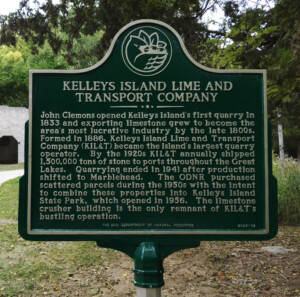 KELLEYS ISLAND LINE & TRANSPORT CO. (side 1)
End of Division St. through the parking lot by the trail entrance.
READ MORE about the history of this company and the limestone that they quarried.
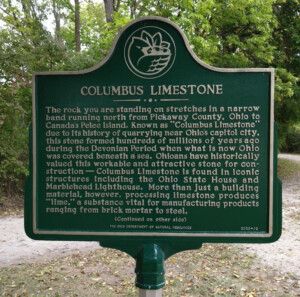 COLUMBUS LIMESTONE (side 2)
North end of Division Street