
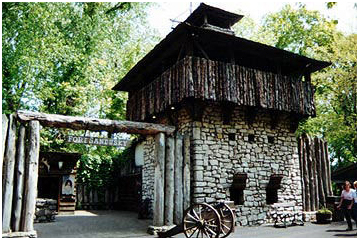
 FORT SANDUSKY
Cedar Point built a replica of the fort at Frontier Land. Pretty Cool; however Touring Ohio says: It should be noted that this only an interpretation of what an Ohio Country fortification looked like. It in fact has very little in common with any frontier fortification other than picketed logs. None of Ohio’s fortifications would have had stone walls. The height of the log walls are close in height and size. Most forts on the western frontier did not have artillery pieces. A few fortifications did have artillery pieces like Fort Meigs and Fort Stephenson. READ MORE
The Battle of Fort Sandusky was one of many clashes during Pontiac’s Rebellion in 1763. The Native American leader gathered several tribes in a loose alliance and attacked British forts throughout what is now Ohio and Michigan. The fort’s establishment violated the British 1758 Treaty of Easton with Ohio Country Indians, which had promised no additional forts would be built in their territory. On May 16, 1763, during Pontiac’s Rebellion, a group of Wyandot gained entry under the pretense of holding a council with the British; chiefs seized the commander while warriors killed the fifteen-man garrison, then killed a number of British traders and burned the fort. The Wyandot took Pauli hostage, but he escaped and made his way back to the burned fort, where he met with a British relief party before departing for Fort Detroit. A larger British contingent arrived in Sandusky Bay the following year and began rebuilding the fortification, but the effort was never completed and plans to rebuild were abandoned. (From Explore Forts)
One of the requirements for updating this historic marker was verifying that each and every statement was true. this included meeting with the Wyandot Nation. An article appeared in the Sandusky Register about the history of the Wyandots in this area. You can READ IT HERE.
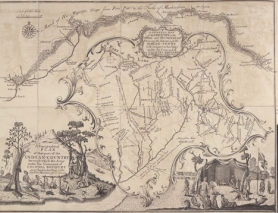 For a hundred years, controversy has raged over its location. It has been variously placed all the way from the mouth of Pipe Creek to Fremont, in Ohio. One writer even goes so far as to locate it on the Marblehead Peninsula near Port Clinton and then after badly confusing the data by unwarranted assumptions winds up by twice showing a sketch of De Lery’s French Fort Sandusky and the second time indexing it in the book – “Fort Stephenson as sketched by De Lery” – thereby not only confusing two separate forts but confusing Pontiac’s War of 1763 with the War of 1812. Fort Stephenson was sometimes called Fort Sandusky. Henry Howe in his Historical Collections of Ohio does so. But De Lery who records French Fort Sandusky on the Marblehead Peninsula had been dead thirteen years when Fort Stephenson was built, and Howe’s text and sketches leave no room for any confusion as to the fact he means Fort Stephenson of the War of 1812. We shall examine a few documents in an effort to straighten this out, but first here again is the usual story about British Fort Sandusky. READ MORE