
VILLAGE OF MILAN, MILAN TWP. & AVERY HISTORIC MARKERS
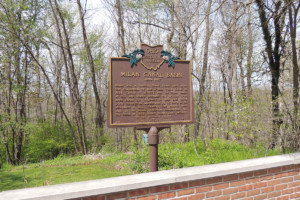
 CAMP AVERY
Marker is near Avery on River Road 0.3 miles south of East Mason Road, on the left when traveling south.
1811 One-fourth mile southwest from the site on the brow of the hill overlooking the eastern bank of the Huron River, Gen. Simon Perkins, commanding the Ohio Militia, built the fortifications and block house of Camp Avery for protection of early settlers from British and Indians. County Seat – 1811 On this site was located Avery, first county seat of Huron County. Here stood the two story log house used as a court house and jail. 1818 County seat moved from here to Norwalk. 1838 Erie County was established from the northern part of Huron County. This locality was frequented by tribes of Indians: Ottawas, Miamis, Chippewas and Senecas. READ MORE
[/fusion_text]
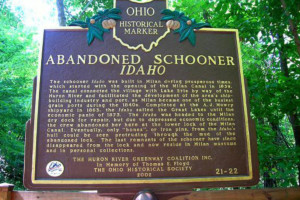
ABANDONED SCHOONER IDAHO
Unable to locate this marker, formerly identified as Mason Road (Cty Rd #13) Trailhead, Milan Township, just north of Mason Rd.
The schooner Idaho was built in Milan during prosperous times, which started with the opening of the Milan Canal in 1839. The canal connected the village with Lake Erie by way of the Huron River and facilitated the development of the area’s shipbuilding industry and port, as Milan became one of the busiest grain ports during the 1840s. Completed at the A. J. Mowry shipyard in 1863, the Idaho sailed the Great Lakes until the economic panic of 1873. The Idaho was headed to the Milan dry dock for repair, but due to depressed economic conditions, the crew abandoned her here at the lower lock of the Milan Canal. Eventually, only “bones”, or iron pins, from the Idaho’s hull could be seen protruding through the mud of the abandoned lock. The last remnants of the schooner have since disappeared from the lock and now reside in Milan museums and in personal collections.

MILAN’S HOGBACK
30 N Edison Dr, Milan OH
The ridge beginning at the Edison Birthplace and descending to the Village Creek 1/4 mile north of this spot was known, even in Edison’s time, as the Hogback. Shown on an 1805 Moravian map, the street on which you are standing was an Indian trail leading north to Lake Erie. The present street, Edison Drive, was first named Liberty Street and then change to Choate to honor George Washington Choate, a carding and fulling mill owner, whose home was 100 feet north of here. For more information and nearby markers click HERE.
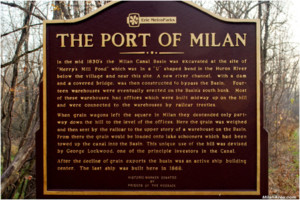 THE PORT OF MILAN
This marker is along the Milan Towpath MetroParks Trailand is at or near 30 N Edison Dr
In the mid 1830’s the Milan Canal Basin was excavated at the site of “Merry’s Mill Pond” which was in a “U” shaped bend in the Huron River below the village and near this site. A new river channel, with a dam and a covered bridge, was then constructed to bypass the Basin. Fourteen warehouses were eventually erected on the Basin’s south bank. Most of these warehouses had offices which were built midway up on the hill and were connected to the warehouses by railcar trestles.
When grain wagons left the square in Milan they descended only partway down the hill to the level of the offices. Here the grain was weighed and then sent by the railcar to the upper story of a warehouse on the Basin. From there the grain would be loaded onto lake schooners which had been towed up the canal into the Basin. This unique use of the hill was devised by George Lockwood, one of the principle investors in the Canal. After the decline of grain exports the basin was an active ship building center. The last ship was built here in 1868.
Erected by Friends Of The Hogback.
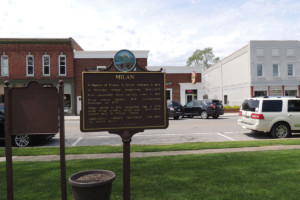 MILAN
Marker is on N. Main Street, on the left when traveling south. Located in Lake Front Park.
Birthplace of Thomas A. Edison, February 11, 1847.
• A Moravian village, Pequotting, 1804–1809.
• First permanent white settlers came in 1816.
• Milan village platted, 1817; incorporated February 23, 1833.
• Ship’s canal to lake completed July 4, 1839, made Milan leading wheat port, 1839–1864, second only to Odessa, Russia.
• Shipbuilding industry flourished, 1842–1867; 75 vessels built.
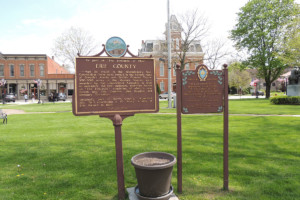 ERIE COUNTY AS PART OF “THE FIRELANDS OF OHIO”
Marker is on N. Main Street, on the left when traveling south. Located in Lake Front Park.
As part of “The Firelands of Ohio”… Erie County had its origin in the Revolutionary War. Connecticut towns were burned in the historic raids of Benedict Arnold and British General Tyron. 500,000 acres in the Western Reserve were awarded by the Connecticut Assembly in 1792 to indemnify the fire-sufferers, therefore known as “The Firelands”: consisting of what is now Huron and Erie Counties, plus Ruggles and Danbury Townships. Originally part of Huron County, organized 1811, first courthouse at Fort Avery: County of Erie formed in 1838.
 MILAN CANAL BASIN
Marker is on North Edison Drive, 0.1 miles north of Front Street, on the left when traveling north.
Milan was a leading Great Lakes port after the completion of the 3-mile Milan Canal in 1839. Center of activity was the Milan Basin at this site where produce was brought from area farms for shipment to lake and world ports through 14 warehouses by as many as 20 schooners a day. Seventy-five vessels were built in the basin. Railroad competition and the flood of 1868 ended Milan’s port activity. READ MORE
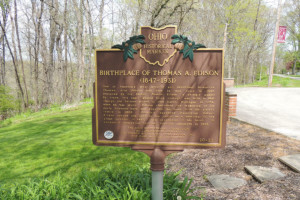 BIRTHPLACE OF THOMAS A EDISON (1847-1931) & EDISON RECALLS MILAN
Marker is on East Edison Drive, on the right when traveling south, in front of Edison museum
Side 1: One of America’s most prolific and important inventors, Thomas Alva Edison was born in this house in 1847. Designed by his father, Samuel Edison, a shingle maker by trade, this small gabled brick cottage was built in 1841. Though the Edisons moved to Port Huron, Michigan, in 1854, when he was seven, Edison cherished the memories of his early boyhood here and acquired the home from his sister’s family in 1906. Edison’s daughter Madeleine Edison Sloane opened the home to the public as a memorial to the great inventor in 1947, the centennial of his birth. It became a registered National Historic Landmark in 1965. Explore the Edison Birthplace Museum.
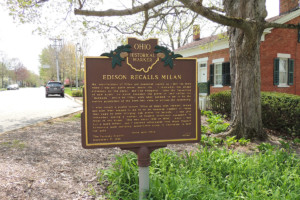 Side 2: My recollections of Milan are somewhat scanty as I left the town when I was not quite seven years old. I remember the wheat elevators on the canal, and Gay shipyard; also the launching of new boats, on which occasion the piece of land called the “Hogbac” would be filled with what seemed to me to be the entire population of the Town who came to witness the launching. I also recall a public square filled at times with farmers’ teams, and also what seemed to me to be an immense number of teams that came to town bringing oak staves for barrels. I can just remember seeing a number of Prairie Schooners encamped in front of our house. This was about 1849 or 1850, when I was but a mere infant, and I learned afterwards that these Prairie Schooners were carrying adventurers going to California to hunt for gold. Yours very truly,