
VERMILION & VERMILION TWP HISTORIC MARKERS
 THE FORMER SITE OF CRYSTAL BEACH PARK
Crystal Beach Park opened for the first of its 56 seasons on Decoration Day (now referred to as Memorial Day) Thursday May 30, 1907. The 42 ½ acres had been owned by the George Shadduck family since 1854. It was at one time a stagecoach stop and later became a popular picnic grove for an ever growing number of visitors.
The founders of Crystal Beach Park were George and Josephine Blanchat. They purchased the property in 1906. The twenty-two and a half acres along Lake Erie developed into the amusement park.
The twenty acres south along the roadway, where the shopping center is today, was the parking lot. The name of the park is attributed to Josephine Blanchat. This occurred when on a walk along the beach with her husband she had picked up a handful of sand and remarked, “It looks like crystal.”
Crystal Beach Park started with just a beer garden that later was turned into a dining hall. A carousel and shooting gallery completed the earlier attractions. Over the years a variety of other rides and concessions were added. There were popular rides like the Thriller, Tumble Bug, Dodgem. Ferris Wheel, Loop-O-Plane, Kiddie Rides, Left in the Dark and Rocket Ships. The park hosted at one time or another as many as 15-20 rides. A midway of concession games, a miniature 18 hole golf course, and for a time Jungle Larry’s Safari, offered other sources of enjoyment.]
During the big band era of the 1930’s through the 1950’s such band leaders as Tommy Dorsey, Stan Kenton, Guy Lumbardo, Gene Krupa, Louis Armstrong, Duke Elington, Les Brown with Doris Day, Vaughn Monroe, Sammy Kaya, Cab Calloway, Xavier Cugal, Ray Anthonly, Ralph Flanagan, and Woody Harman, performed before large audiences at the Crystal Beach ballroom. Singing groups such as the Everly Brothers, Four Freshmen, Four Lads and Kingston Trio later joined the list of famous entertainers.
Following the passing of George and Josephine Blanchat the ownership of the park was taken over by their daughters Thelma and Eleanor. With their husbands Jim Calvert and Jimmy Ryan (manager), and the grandchildren Marlene Calvert (Feldkamp), and Calvert (Mueller) and Tom Ryan the operation of a family owned park would continue until it was sold in 1962.
Dedicated to all those who worked at and remember Crystal Beach Park. READ MORE
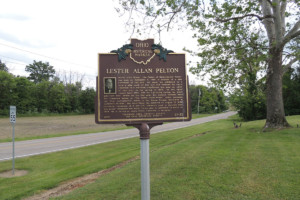 LESTER ALLAN PELTON
Risden & Lake Road, Vermilion Township, OH- Cuddeback Cemetery
Lester Allan Pelton, “the Father of Hydroelectric Power,” was born on September 5, 1829, a quarter of a mile northwest of this site. He spent his childhood on a farm a mile south of this site and received his early education in a one-room schoolhouse that once sat north of this site. In the spring of 1850, he and about twenty local boys, left for California during the great gold rush west. Pelton did not find gold, but instead invented what was commonly known as “the Pelton Water-Wheel,” which produced the first hydroelectric power in the Sierra Nevada Mountains in California in 1887. The Water-Wheel was patented on August 27, 1889. Currently variations of it are still commonly used to generate electric power throughout the world. Pelton died in California on March 14, 1908. He is buried at Maple Grove Cemetery in Vermilion. READ MORE
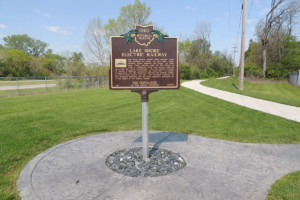 LAKE SHORE ELECTRIC RAILWAY
Rotary Park, located at base of Vermilion’s Water Tower
At this site the Lake Shore Electric Railway crossed a bridge that spanned the Vermilion River. The western abutment of the former bridge is plainly visible just below along the river bank. Widely known as the “Greatest Electric Railway in the United States,” the flaming orange trolley cars of the Lake Shore Electric Railway transported people and freight for thirty-seven years (1901-1938) along the southern Lake Erie shores from Cleveland to Toledo often reaching speeds of sixty miles per hour. The interurban line played a primary role in the development of the western Cleveland suburbs and also carried throngs of summer visitors to Lake Erie recreation facilities at Avon Beach Park, Linwood Park, Crystal Beach, Mitiwanga, Ruggles Grove, Rye Beach, and Cedar Point. The power lines still standing along the system’s right-of-way attest to the fact that it also assisted in bringing electric power to the entire region. READ MORE
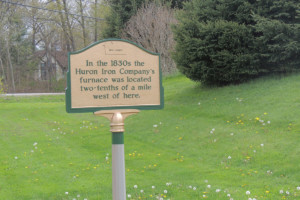 HURON IRON COMPANY
Route 60 (State Rd) near Darrow Road, Vermilion OH
In the 1830s the Huron Iron Company’s furnace was located two-tenths of a mile west of here.
Furnaces on the Vermilion River – Iron – About 60 feet north of Huron Street along the riverfront were two stone foundations, round in shape 10′ in diameter and 2′ high. Around the foundations the ground was tinged red, the sign of iron ore. These two furnaces were the first stacks of the Geauga Iron Company of Painesville built in 1828-30. They had a dock and warehouse nearby on the river. Later they moved back on the ridge as the Huron Iron Company west of the State Road. This business operated for many years until coke made charcoal furnaces obsolete. The Huron Iron Company ceased operations in 1865. for more info about the history of the Vermilion River click HERE.
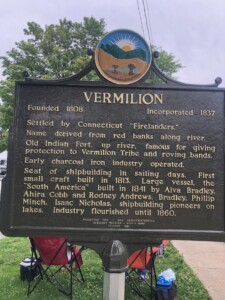 VERMILION – ERIE COUNTY
Main Street (Ohio Route 60) north of Ohio Street, on the right when traveling north. Located in Victory Park.
Side 1 – Vermilion
Founded 1808, incorporated 1837.
Settled by Connecticut “Firelanders.” Name derived from red banks along river. Old Indian Fort, up river, famous for giving protection to Vermilion Tribe and roving bands. Early charcoal iron industry operated. Seat of shipbuilding in sailing days. First small craft built in 1813. Large vessel, the “South America” built in 1841 by Alva Bradley, Ahira Cobb and Rodney Andrews. Bradley, Phillip Minch, Isaac Nicholas, shipbuilding pioneers on lakes. Industry flourished until 1860. Erected 1953 by the Ohio Sesquicentennial and the Sandusky Register-Star-News, founded in 1833.
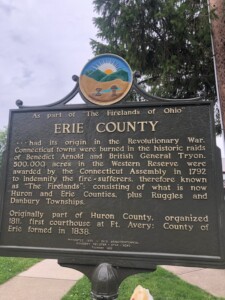 Side 2 – Erie County
As part of “The Firelands of Ohio” Erie County had its origin in the Revolutionary War. Connecticut towns were burned in the historic raids of Benedict Arnold and British General Tryon. 500,000 acres in the Western Reserve were awarded by the Connecticut Assembly in 1892 to indemnify the fire-sufferers, therefore known as “The Firelands;” consisting of what is now Huron and Erie Counties, plus Ruggles and Danbury Townships.
Originally part of Huron County, organized 1811, first courthouse
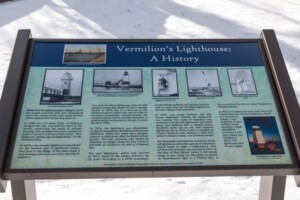 VERMILION LIGHTHOUSE
Located in Harborview Park
In 1847 a lighthouse was placed on the western pier. It was replaced by new lighthouse, which was erected in 1877, and stood at the harbor entrance for 52 years. In 1876, the lighthouse was dilapidated. Congress appropriated $3,000 to build an iron lighthouse, which was made from obsolete cannons melted down after the Battle of Fort Sumter. It stood on the site for 52 years. In 1929 it was dismantled. However, the Wakefield brothers erected this 34-foot-tall structure in 1991 at the foot of Main Street, where it still stands today. READ MORE about the history of this structure and then marker’s text.
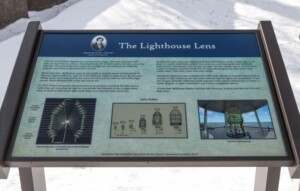 THE LIGHTHOUSE LENS
Location: Marker is on Main Street north of Huron Street, on the left when traveling north. It is at the foot of Main Street in Harbor View Park near the Vermilion lighthouse. This marker is the one of the left. The Vermilion Lighthouse is on the grounds. The lens in Vermilion’s lighthouse is powered by a single, 100-watt-equivalent LED bulb, no more than an ordinary household lamp. Yet its light reaches 10 miles out across Lake Erie. The technology that makes this possible was developed in the 1800s by Augustin-Jean Fresnel (pronounced Fruh-nell). Before that time, lighthouses were lit with single or multiple lamps burning whale oil. READ THE FULL TEXT
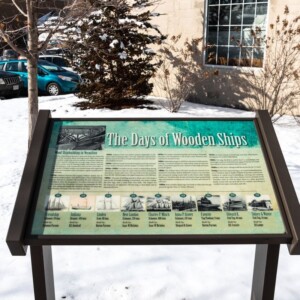 DAYS OF WOODEN SHIPS – WOOD SHIPBUILDING IN VERMILION
Location: Liberty Avenue (U.S. 6) west of Grand Street, on the right when traveling west. It is at Friendship Park which is on the grounds of the public library. 5680 Liberty Ave, Vermilion OH 44089.
Solomon Parsons and Captain William Austin, two of Vermilion’s earliest settlers, were the founders of local shipbuilding legacies. Parsons is credited with building the first schooner in Vermilion in 1814. READ THE FULL TEXT
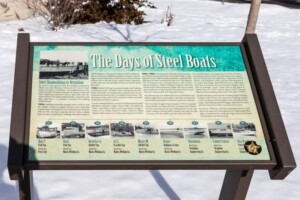 THE DAYS OF STEEL BOATS
STEEL SHIPBUILDING IN VERMILION
Location: Liberty Avenue (U.S. 6) west of Grand Street, on the right when traveling west in Vermilion. It is at Friendship Park which is on the grounds of the public library.
By 1920 it was apparent that the building material of choice was steel. Between 1920 and 1957 over 25 steel boats were built in Vermilion. The establishment of the American Ship Building Company in nearby Lorain and other supporting industries such as steel mills and railroads, drained Vermilion of blacksmiths, carpenters, and ship carpenters — a workforce necessary for crafting wooden boats. READ THE FULL TEXT

FIRELANDS “SUFFERERS”
Located on Liberty Avenue (U.S. 6) 0.2 miles east of Main Street, on the right when traveling west. The marker is on the north side of the street, just a few steps to the east of the public comfort station.
In 1792 the half mil. acres of the Firelands were given to CT property owners of New London, New Haven, East Haven, Greenwich, Danbury, Fairfield, Ridgefield and Groton as recompense for land lost due to British fire raids fueled by anger over the citizens’ aid to the Continental Army. It is the only land ever granted to civilian victims of war in American History. Firelands Chapter Daughters Of The American Revolution.

THE KISHMAN FISH COMPANY
Marker is at or near 5472 Liberty Avenue, Vermilion OH
Adam Kishman began his fishing business in 1864, four miles east of Vermilion, on the shore of Lake Erie. He used simple nets and boats to harvest his catch. His work force consisted of family members and local farmers, who assisted in their spare time. The fish were packed on ice, which had been harvested from Lake Erie, and then distributed by wagon and rail.
In 1905, Adam’s son, Henry, relocated the thriving business to the west bank of the Vermilion River and named it The Kishman Fish Company. They started with one tug and the operation increased rapidly. With advancements in technology, such as diesel power and electricity, the business continued to grow and expanded to three locations along the south shore of Lake Erie. In 1931, Henry’s son, Lester, became involved in the family business and; upon Henry’s death in 1948, became President.
Through the years, The Kishman Fish Company had become an important part of the local economy and history of Vermilion. In the 1970s, commercial fishing began to decline due to overfishing and environmental and legislative restrictions. The Kishman Fish Company closed in 1984. The Fisherman’s Bend condominiums now occupy the. former site of The Kishman Fish Company.