
 HINDE & DAUCH PAPER COMPANY
The massive three story brown brick building to the west of the Jackson Street Pier is now the Chesapeake Lofts, home to luxury condominiums offering a splendid view of Sandusky Bay. However, in its previous life a portion of the building housed shops and the famous Norman Hall. Later it was a manufacturing facility for corrugated paper boxes and other products.
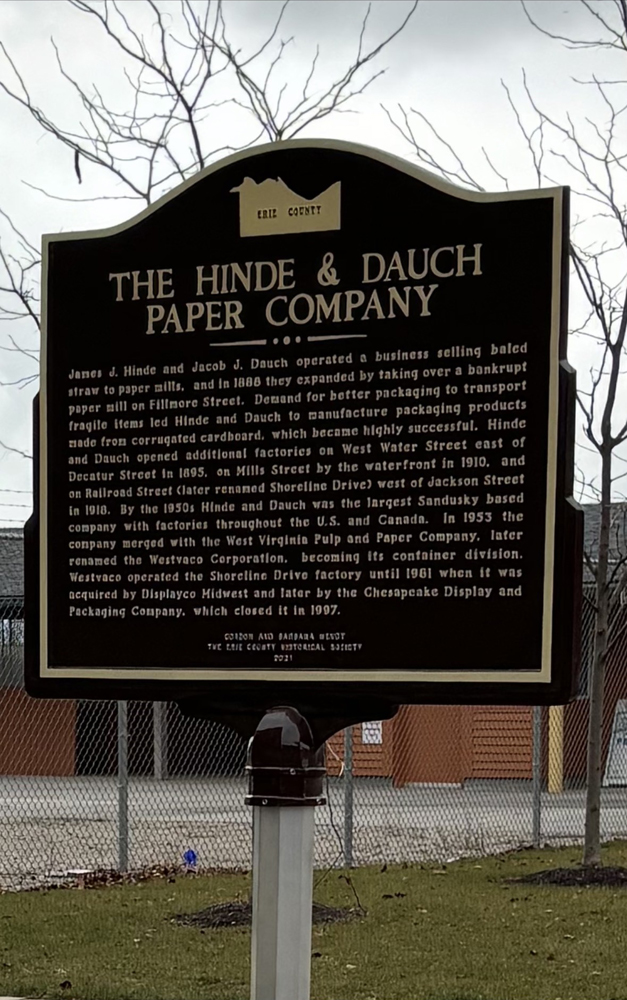 HINDE & DAUCH PAPER COMPANY & THE PAPER DISTRICT
300 W. Shoreline Dr., Sandusky OH
SIDE 1 – HINDE & DAUCH – James J. Hinde and Jacob J. Dauch operated a business selling baled straw to paper mills, and in 1888 they expanded by taking over a bankrupt paper mill on Fillmore Street. Demand for better packaging to transport fragile items led Hinde and Dauch to manufacture packaging products made from corrugated cardboard, which became highly successful. Hinde and Dauch opened additional factories on West Water Street east of Decatur Street in 1895, on Mills Street by the waterfront in 1910, and on Railroad Street (later renamed Shoreline Dive) west of Jackson Street in 1918. By the 1950s Hinde and Dauch was the largest Sandusky based company with factories throughout the U.S. and Canada. In 1953 the company merged with the West Virginia Pulp and Paper Company, later renamed the Westvaco Corporation, becoming its container division. Westvaco operated the Shoreline Drive factory until 1981 when it was acquired by Displayco Midwest and later by the Chesapeake Display and Packaging Company, which closed it in 1997. Made possible through a donation by Gordon & Barbara Wendt. The Hinde and Dauch Co. is featured on the Downtown Sandusky Historic Walking Tour.
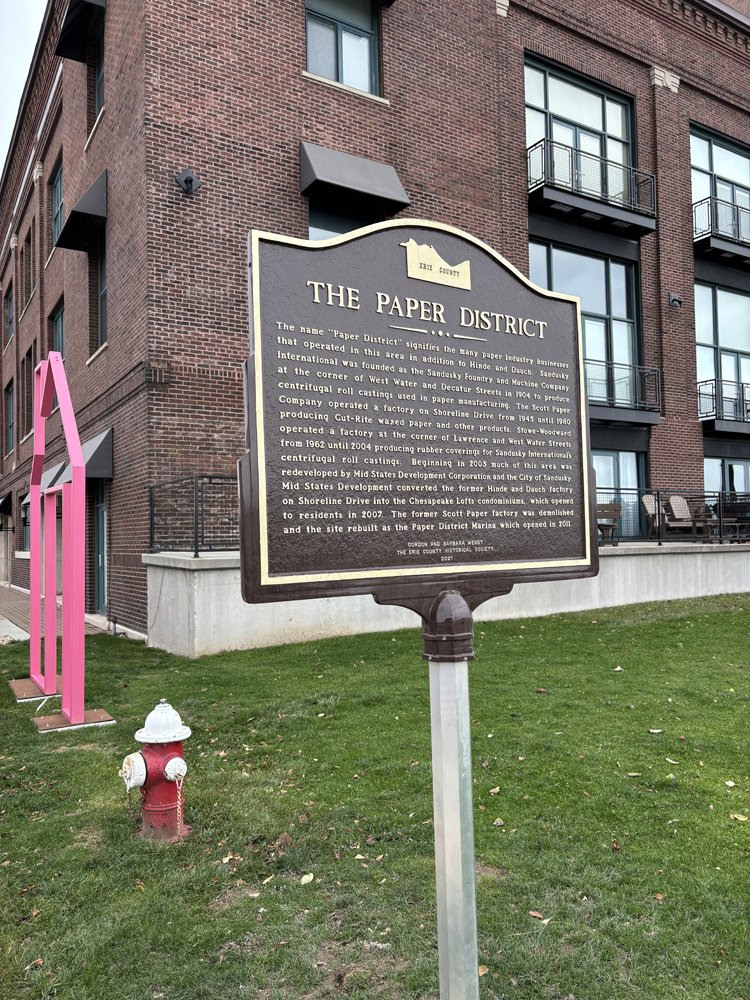 Side 2 – THE PAPER DISTRICT
The name “Paper District” signifies the many paper industry businesses that operated in this area in addition to Hinde and Dauch. Sandusky International was founded as the Sandusky Foundry and Machine Company at the corner of West Water and Decatur Streets in 1904 to produce centrifugal roll castings used in paper manufacturing. The Scott Paper Company operated a factory on Shoreline Drive from 1945 until 1980 producing Cut-Rite waxed paper and other products. Stowe-Woodward operated a factory at the corner of Lawrence and West Water Streets from 1962 until 2004 producing rubber coverings for Sandusky International’s centrifugal roll castings. Beginning in 2003 much of this area was redeveloped by Mid States Development Corporation and the City of Sandusky. Mid States Development converted the former Hinde and Dauch factory on Shoreline Drive into the Chesapeake Lofts condominiums, which opened to residents in 2007. The former Scott Paper factory was demolished and the site rebuilt as the Paper District Marina which opened in 2011. Made possible through a donation by GORDON AND BARBARA WENDT
 Hinde & Dauch sign revealed – In May 2020 it was reported that “Ongoing repair work at downtown’s Chesapeake Lofts involves uncovering a previously obstructed sign, spelling out “The Hinde & Dauch Paper Co.,” on the building’s apex looking out toward West Shoreline Drive.”
 This is the Jackson Street dock.

In 1886, first generation local farmers James J. Hinde and Jacob J. Dauch saw an opportunity to enter the paper making business when a customer for their baled straw went bankrupt. Hinde and Dauch Paper Company (which no longer exists) rented the building in 1897. The building and neighboring buildings were incorporated into a five-story building, ending its days as a performance hall. Hinde proved to be an excellent businessperson, developing a process to manufacture corrugated cardboard packaging materials. At the time, companies faced a major challenge in shipping more fragile goods. Hinde’s new packaging helped to solve this problem. The company grew quickly and became very successful.
June 2, 1870 – The practice of bathing, by men and boys, in front of many of the docks during almost every hour of the day, is an indecent nuisance. Complaints are rife that ladies are obliged to keep away from the shores of the Bay, and the eve is becoming intolerable. It is the duty of the City Marshall to take notice of this matter, and enforce the ordinance by arresting offenders.
 Hinde left the company in 1910 to pursue other interests, but Dauch continued to run the company and in 1918 centralized the company’s manufacturing in the building you see here today. Dauch died unexpectedly on August 16, 1918 in an automobile accident. The land east of the building was sold by his heirs to the City of Sandusky and today is the location of the Jackson Street Pier.
In 1953, Hinde and Dauch merged with the West Virginia Pulp and Paper Company to form the Westvaco Corporation. The new company operated the facility until 1981, when it was closed and was ultimately donated to the City of Sandusky.
In 2005, Gordon Wendt wrote a wonderful history of the Big Red Factory – The Hinde & Dauch Paper Company. Gordon was well versed in the history of the company and this building because he was a 3rd generation Hinde & Dauch employee! In his paper, he writes about the company’s early days (H & D was originally located in the Keller Building in 1913) and the decision to construct this large building. He describes Railroad Street and the wood bridge over the tracks. Did you know that the pier was not always rectangular shaped and that Sidney Frohman became President after J. J. Dauch was unexpectedly killed in an accident? There are loads of historical tidbits here including a construction photo from 1917 and a description of the various buildings including C, K, and M. This is a wonderful read and you can view it here: The Big Red Factory – Hinde & Dauch.
Gordon wrote another article about the early days of Hinde & Dauch, before their move to the lakefront location. This article tells the story of the Keller building location and Norman Hall. Keller Building History

NORMAN HALL
Norman Hall was probably the first structure built in Sandusky primarily as a theater and concert hall. The building was constructed in 1855 on Water Street. The Hall itself was on the second floor, while the first floor was home to several and varied storefront businesses. The first floor was retail space, and the performance hall was upstairs. The hall was a showpiece of elaborate wood, plaster and fresco painting work with an impressive stage. The Sandusky Register reported: “This hall promises to be the finest in this state.” Through the years, Norman Hall played host to famous speakers, including abolitionist and well-known orator Frederick Douglass on March 16, 1861, during the civil War. His lecture, titled “Mission of the War.”
April 1, 1861 – Upp Brothers Wholesale Dealers in Salt Fish of all kinds, Salt, Waterlime, Land and Calcine Plaster, Hams and Shoulders, Family Vinegar, lake Ice, &c. Store Room Nos. 234 and 236, (first door west of Norman Hall) Water Street.
The theater also had a variety of performers, including little people like Tom Thumb, a boy who had stopped growing at 25 inches and was put on display by New York showman P. T. Barnum. An 1869 advertisement for a performance by Thumb, whose real name was Charles Stratton, boasted he and others like him would be at Norman Hall. They had just returned from Europe, where “they appeared before nearly all the kings, queens, emperors and nobility of the old world.”
December 18, 1863 – Sandusky School students presented a musical entertainment at the Hall – Read all about it HERE.
January 24, 1884 – Roller Skating – The above popular amusement has been revised for this week only and the Social Turner’s Hall (formerly Norman Hall) presents its old time lively appearance. The floor is in splendid condition and for an evening of enjoyment, go to the Roller Rink. Admission 25 cents. Skates 10 cents.
October 7, 1891 – New Cigar Factory – Mr. John Witworth has leased the old Norman Hall building on Water Street to Hautzenraeder & Co. of Mansfield for a cigar factory. The firm employs 300 hands at its factory in Mansfield and the business sin this city will be operated as a branch with probably 150 employees, mostly girls, who will prepare the leaf for use at the main factory. A large number of girls have already been employed as a result of the advertisement which appeared in the Register yesterday morning and the parties who have leased the building will come here next week to begin active operations.