
 THE FOLLETT HOUSE
404 Wayne St.
Oran Follett, who was the publisher of the Lincoln-Douglas Debates, resided at 404 Wayne Street.
Follett House, ca. 1870-1900. Image courtesy of Sandusky Library Archives Research Center
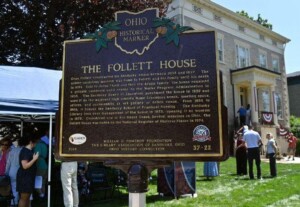 THE FOLLETT HOUSE (Side 1) – Oran Follett constructed his Sandusky house between 1835 and 1837. The golden sandstone mansion was home to Follett and his family until his death in 1894. Sold to James Flynn and then the Krupp family, the house remained a private residence until rented to the Works Progress Administration in 1935. The Sandusky Board of Education purchased the house in 1939 and used it as the adjacent high school’s Home Economics annex, meeting space, offices, and occasionally as art gallery or dance venue. From 1958 to 1968, it housed the Sandusky School of Practical Nursing. The Sandusky Library took over management of the house in 1973, opening it as museum in 1976. Considered one of the finest Greek Revival mansions in Ohio, the Follett House was listed on the National Register of Historic Places in 1974. Here is the Follett House page: https://www.sanduskylib.org/historymuseum
Oran Follett and his wife were part of the Underground Railroad. His house was built in the 1830s and is now a museum. In 2026 it was renamed the Sandusky History Museum at the Follett House. The Follett House is featured on the Washington Park Historic Walking Tour and the Underground Railroad Historic Walking Tour.
 ORAN AND ELIZA FOLLETT (Side 2) – Oran Follett (1798-1894) was born in Gorham, New York. He made his mark as a newspaper editor and publisher and served one term in the New York Legislature. In 1832 he married his second wife, Eliza Gill Ward (1801-1876), and moved his family to Sandusky by 1834. In Ohio, Follett served as editor of the Ohio State Journal, founded the Bank of Sandusky, invested in Mad River & Lake Erie Railroad, and was president of Sandusky, Dayton, and Cincinnati Railroad. His Columbus firm, Follett, Foster & Company, published the Lincoln-Douglas Debates and William Dean Howells’ Life of Lincoln, bringing public attention to the fledgling Republican Party. Eliza Follett was a founding member of Sandusky’s Grace Church, a dedicated nurse during epidemics, and is remembered for her involvement in the Underground Railroad.
Erected 2026 by William G. Pomeroy Foundation; The Library Association of Sandusky, Ohio; Ohio History Connection; America 250: Ohio Commission. (Marker Number 37-22.)
 Eliza Follett, Oran’s second wife, was very sympathetic to escaping slaves. According to Eliza’s granddaughter, “No one knows how many slaves she concealed in the basement…or out in the woodshed. She warmed, fed and clothed them, then aided them in their escape across Lake Erie to Canada.” Follett’s “sympathies, too, were with the slaves, but he would remonstrate with her: ‘Wife, it is against the law.’ ‘Husband, there is a higher law,’ she would reply.” Although more stories about the role of men were preserved, white and black women also played a significant role in the Underground Railroad movement.
After Sloane was convicted in Federal Court, he was honored by the First Regular Anti-Slavery Baptist Church. As part of the church’s recognition, John Lott presented a silver-headed cane to Sloane for his work in helping runaway slaves escape to freedom. The cane (which is at the Follett House today) has an inscription that reads: “From the colored citizens of Sandusky, Ohio.”
Note: The Follett House is open to the public and operated as a museum. Visit www.sandusky.lib.oh.us/follett_house for hours of operation. The museum has an outstanding local history collection featuring Sandusky and Erie County artifacts.
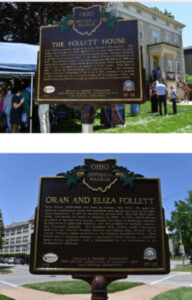 In July 2026, the new 2-sided Historic Marker was dedicated, and the Follett House museum was renamed the Sandusky History Museum at the Follett House. You can read the Sandusky Register article HERE.
 The old marker, which was named Oren Follett, had succumbed to age and is now part of the collection houses in the museum.