
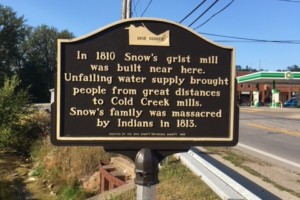
 SNOW’S GRIST MILL
In 1820 Docartus Snow of Vermont and others founded a settlement here and called it Cold Creek. He built the first grist mill (of logs) in the Firelands area, upon the offer of 100 acres of land. His mill could grind 15 bushels of corn in 24 hours. But after two years he and the others were driven out by fear of the British and the Indians. Yet they bravely returned the year following. At this time the population of Castalia consisted of three families and two bachelors; twenty-nine persons. The families settling here with the Snows were the Butler’s and the Putnam’s.
Soon corn was missing at Snow’s grist mill; the Indians were stealing it. So, he devised loose boards which, like trap-doors, dumped them out and raised a loud clatter. Some say this caused the Indians to be so angered that they planned revenge. One day, while the men worked at about a mile northward in their fields, on June 2, 1813, a group of Indians (some say they were Pontiac’s and from the Detroit area) attacked the homes. Violently they took all the women and children as prisoners, except those they killed: Snow’s and Butler’s two year old sons, Julia Butler four years old, and Snow’s wife. The children were tomahawked for hiding. Mrs. Snow was dragged from a sick bed. Unable to keep pace with the party, she was killed along the trail. The rest were taken to Detroit, and released the next Fall. Their friends heard what happened soon enough, but could not communicate with them, as Detroit was in British hands. Snow’s son is buried in Castalia cemetery. His second wife later married Philip Cowell; their granddaughter is Mrs. Chas. Dole. Cowell set aside two acres for the cemetery, as his deed stipulated. Two muskrat trappers were later killed by Ottawa Indians in a cabin. Two of them were caught and hanged.
The dam built by Snow for water-power for his mill caused the subterranean water pressure to break out in a new spring in 1820, forming the present Blue Hole. It had a small diameter at first, but repeated cave-ins brought it to the present size by 1914. The Geological Survey of Ohio says of it: “The water Maintains nearly the same temperature winter and summer, and its flow is more uniform than that of the surface streams of the vicinity, though sensibly affected by periods of unusual and widespread drought. The water of the springs is highly charged with lime, rapidly encrusting any object covered by it, and has deposited a sheet of travertine over an area of several square miles in the vicinity.”
The Cold Creek springs area was evidently a favorite camping place for the Indians from the earliest times. They cultivated fields of corn nearby. Game was plentiful, especially wild turkeys and deer; wolves, skunks and rattlesnakes! https://www.villageofcastalia.com/about